An industrial lathe machine is one of the fundamental machine tools used in manufacturing and metalworking.
It is designed primarily to rotate a workpiece while a cutting tool removes material to create a desired shape, size, or surface finish. From producing shafts and bushings to machining threads, tapers, and precision components, lathe operations support a wide range of industrial applications.
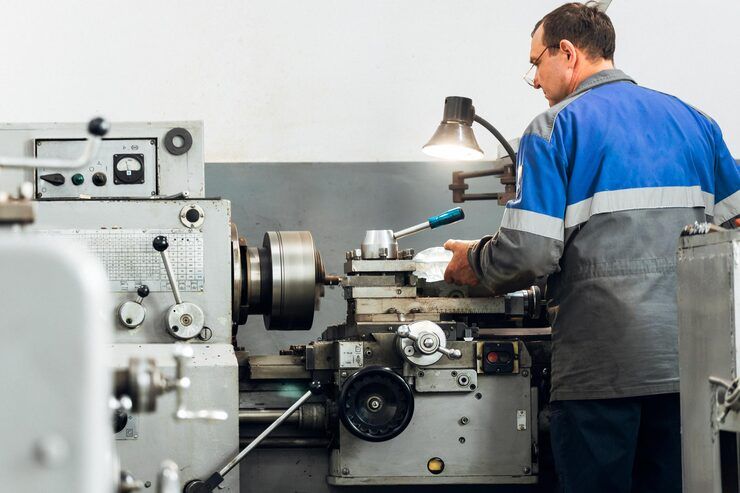
Understanding how an industrial lathe works is useful for manufacturers, engineering students, maintenance professionals, workshop operators, and anyone learning about machining technology. This guide explains the basic working principle, major components, common lathe operations, machine types, tooling considerations, and factors that influence machining performance.
What Is an Industrial Lathe Machine?
An industrial lathe machine is a machine tool used to shape a workpiece by rotating it around a central axis. A cutting tool is positioned against the rotating material and moves in a controlled direction to remove unwanted material.
Unlike some machining equipment that moves the cutting tool around a stationary component, a conventional lathe generally rotates the workpiece while the tool performs the cutting action. This arrangement makes the lathe particularly suitable for producing cylindrical and rotational components.
Industrial lathes can process materials such as steel, stainless steel, aluminum, brass, cast iron, plastics, and other machinable materials. The appropriate machine configuration, cutting tool, speed, feed, and depth of cut depend on the material and the required component specifications.
How Does a Lathe Machine Work?
The basic operation begins by securing the workpiece in a holding device, commonly a chuck or between centers. The spindle then rotates the workpiece at a selected speed.
A cutting tool is mounted on the tool post and positioned against the workpiece. As the material rotates, the tool removes a controlled amount of material. The operator or machine control determines the tool's movement along or across the workpiece.
The main machining variables include:
- Spindle speed: Determines how quickly the workpiece rotates.
- Feed rate: Controls how quickly the cutting tool advances.
- Depth of cut: Determines how much material is removed in one pass.
- Cutting tool geometry: Influences cutting performance, surface finish, and tool life.
- Workpiece material: Affects cutting conditions and tooling requirements.
Balancing these factors helps achieve the required dimensions, surface quality, and machining efficiency.
Main Components of an Industrial Lathe
Although lathe designs vary, several components are common across many machines.
Headstock
The headstock contains the main spindle and drive mechanism. It provides rotational power to the workpiece and may support devices such as chucks and other workholding equipment.
Tailstock
The tailstock is positioned opposite the headstock and can support the free end of a long workpiece. It may also hold tools such as drills and reamers for operations performed along the workpiece axis.
Bed
The bed forms the structural foundation of the lathe. It supports and aligns major components, including the headstock, carriage, and tailstock.
Carriage
The carriage supports and guides the cutting tool. It generally includes the saddle, cross-slide, compound rest, and tool post. Controlled carriage movement allows the tool to travel along the workpiece or move across its diameter.
Chuck
A chuck securely holds the workpiece while it rotates. Different chuck configurations are available for different workholding requirements, including three-jaw and four-jaw designs.
Tool Post
The tool post holds the cutting tool in the required position. Proper tool alignment is important for dimensional accuracy, cutting stability, and surface finish.
Common Lathe Operations
Industrial lathes can perform numerous machining operations, depending on their configuration and tooling.
Turning
Turning reduces the outside diameter of a workpiece. The cutting tool generally moves parallel to the rotational axis while the workpiece rotates.
Facing
Facing produces a flat surface at the end of a workpiece. The cutting tool moves across the end face to remove material and establish the required length.
Threading
Threading creates internal or external threads. The tool follows a controlled path relative to spindle rotation to produce the required thread profile and pitch.
Drilling
Drilling creates a hole along the rotational axis. A drill can be mounted in the tailstock or supported by an appropriate tooling system.
Boring
Boring enlarges or refines an existing hole. It is often used when greater dimensional control or improved internal surface quality is required.
Knurling
Knurling forms a patterned surface on a workpiece rather than removing material in the conventional cutting sense. It can provide a textured gripping surface on selected components.
Taper Turning
Taper turning produces a gradually changing diameter along the length of a component. It is useful for manufacturing parts that require conical or tapered surfaces.
Types of Industrial Lathe Machines
Different manufacturing requirements call for different lathe configurations.
Engine lathes are versatile machines commonly used for general turning, facing, threading, drilling, and other workshop operations.
CNC lathes use computerized controls to automate tool movement and machining sequences. They are suitable for repeatable production and complex machining requirements.
Turret lathes use a turret that can hold multiple tools, allowing several machining operations to be performed with reduced tool-changing time.
Automatic lathes are designed for automated production of repetitive components and can improve consistency in suitable high-volume applications.
Heavy-duty lathes are built for larger and heavier workpieces where greater structural rigidity and machining capacity are required.
The best machine type depends on factors such as workpiece dimensions, material, production volume, component complexity, tolerance requirements, and level of automation.
Cutting Tools and Workholding
Tool selection has a direct effect on machining performance. Common cutting tool materials include high-speed steel and carbide, while specialized applications may use other engineered tool materials.
Tool geometry should correspond to the workpiece material and machining operation. A tool intended for roughing may prioritize material removal and durability, whereas finishing applications often require geometry suited to achieving a smoother surface.
Workholding is equally important. Chucks, collets, centers, and other fixtures help maintain workpiece stability. Secure and accurate workholding reduces unwanted movement and contributes to consistent machining results.
Factors That Affect Lathe Performance
Several variables influence the quality and efficiency of a lathe operation. Machine rigidity is important because vibration or deflection can affect dimensional accuracy and surface finish. Proper workpiece alignment also helps prevent machining errors.
Cutting speed, feed rate, and depth of cut must be selected according to the material, tool, machine capability, and desired result. Excessive cutting conditions can accelerate tool wear, while overly conservative settings may reduce productivity.
Coolants or cutting fluids may also be used where appropriate to control heat, reduce friction, improve chip evacuation, and support tool performance. Their selection and use should follow the machine, tooling, material, and workplace requirements.
Industrial Lathe Safety Basics
Safe operation requires appropriate training and adherence to established workplace procedures. Operators should understand the machine controls, workholding system, tooling, and operating limits before machining.
Loose clothing, jewelry, and other items that could become caught in rotating machinery should be avoided. Workpieces and cutting tools must be securely installed, and machine guards should be used where provided.
The machine should be stopped before making adjustments that require access to hazardous moving areas. Chips should be handled with suitable tools rather than by hand, and the work area should remain clean and organized.
How to Choose the Right Lathe
Selecting an industrial lathe starts with understanding the intended machining work. Important considerations include maximum workpiece diameter, distance between centers, spindle capacity, motor capability, machine rigidity, tooling options, control system, and expected production volume.
For repetitive manufacturing, CNC capabilities and automated tool management may be important. For general-purpose workshop work, a versatile conventional lathe may provide the necessary functionality. Larger components may require a heavy-duty configuration with suitable swing and load capacity.
The objective is to match the machine's capabilities with actual machining requirements rather than selecting equipment based only on general specifications.
Frequently Asked Questions
What is an industrial lathe mainly used for?
An industrial lathe is mainly used to machine rotational workpieces. Common applications include turning, facing, threading, boring, drilling, taper turning, and other related operations.
What is the difference between a conventional and CNC lathe?
A conventional lathe is operated primarily through manual controls, while a CNC lathe uses programmed computer control to manage machining movements and operations. CNC machines are particularly useful for repeatable and automated production.
What materials can a lathe machine process?
Depending on the machine and tooling, lathes can process many metals and engineered materials, including steel, aluminum, brass, cast iron, stainless steel, and selected plastics.
Why are spindle speed and feed rate important?
Spindle speed and feed rate directly influence cutting conditions, tool wear, productivity, surface finish, and dimensional results. They need to be selected according to the material, tooling, operation, and machine capability.
Conclusion
The industrial lathe machine remains an essential part of modern machining because it can perform a broad range of operations on rotational components. Its basic principle is straightforward: the workpiece rotates while a cutting tool removes material in a controlled manner. However, achieving accurate and consistent results requires an understanding of machine components, tooling, workholding, cutting conditions, and safe operating practices.
Whether the application involves general workshop machining, precision component production, or automated manufacturing, understanding lathe operations provides a strong foundation for learning how industrial machining systems transform raw material into accurately shaped components.